Minecraft Copper: Oxidation, Waxing and Everything It Builds
Copper weathers from orange to green, builds everything from grates to golems, and powers lightning rods and spyglasses. Here is how to mine it, wax it, scrape it and put it to work.
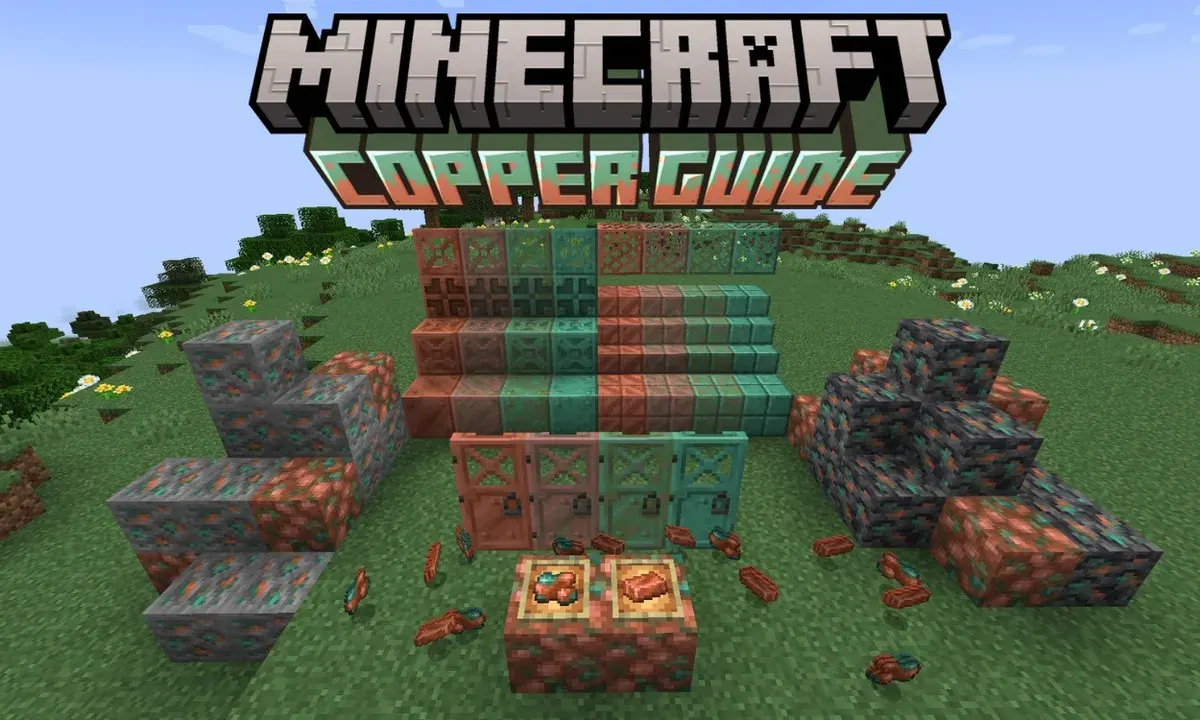
Copper weathers from orange to green, builds everything from grates to golems, and powers lightning rods and spyglasses. Here is how to mine it, wax it, scrape it and put it to work.
Copper is Minecraft's most characterful building metal: you mine it as an orange ore, smelt it into ingots, and then watch whatever you build with it slowly weather from bright orange to a deep teal-green — unless you wax it to freeze the colour you like. Along the way it gives you lightning rods, spyglasses, a whole family of decorative blocks, and one of the game's most charming helpers, the copper golem.
Where do you find copper, and how do you process it?
Copper ore is common at moderate heights in ordinary stone, and genuinely abundant in dripstone caves, where it generates in much larger veins than anywhere else. Mining it drops raw copper — several pieces per block, and more with a Fortune pickaxe — which smelts or blasts into copper ingots, exactly like iron or gold. Deepslate copper ore exists too, in the usual deep layers, though the dripstone veins make long deepslate hunts unnecessary.
Nine ingots make a block of copper for compact storage. Copper is plentiful enough that most players treat it as a building material first and a functional metal second, and a single dripstone cave trip can stock an entire weathered-roof project.
What can you build with copper?
The building family is extensive. A copper block can be cut into cut copper, stairs and slabs, and newer additions round out the set: chiseled copper, copper grates with their see-through lattice, copper bulbs that light up when powered by redstone and stay lit until powered again, plus copper doors, trapdoors and chests. Nearly all of them exist in every oxidation stage, so a roof can deliberately mix fresh, half-weathered and fully green pieces.
Copper has functional crafts too. Copper ingots build early-game tools and armour that sit between stone and iron in strength — handy in the first days before your iron supply is secure. Three ingots stacked vertically make a lightning rod, and an amethyst shard with two ingots makes a spyglass.
How does copper oxidation work?
Unwaxed copper left in the world slowly oxidises through four stages: fresh copper, exposed copper (duller and browner), weathered copper (patches of green spreading), and oxidised copper (fully teal-green). The process is random and gradual — neighbouring blocks change at different rates, which is exactly what gives an ageing roof its natural, mottled look. There is no timer to watch; blocks simply tick over to the next stage when their number comes up.
Every copper block, grate, bulb, door and golem follows the same rules. Oxidation is purely cosmetic for blocks — an oxidised door works exactly like a fresh one — though the copper bulb does dim as it weathers, which redstone builders use as a rough age indicator.
How do you stop oxidation, or reverse it?
To freeze a block at the stage you like, use honeycomb on it. Waxing locks the colour permanently, and waxed pieces can also be crafted directly by combining the block with honeycomb in a grid. Waxed copper shows a faint sheen cue when you interact with it, but otherwise looks identical to its unwaxed twin at the same stage.
To go backwards, use an axe. Scraping a waxed block removes the wax first; scraping an unwaxed block knocks it back one oxidation stage, so a fully green block needs three scrapes to shine again. Lightning does the job too — a strike on or near copper strips oxidation away, one more reason lightning rods and copper roofs are such good neighbours.
What does a lightning rod actually protect?
A lightning rod draws lightning strikes from a wide area around it down to a single safe point. Mount one on your highest roof and storms will hit the rod instead of your wooden barn, your thatch, or your penned-up villagers. The strike is harmless at the rod itself, and redstone builders also use rods as compact storm detectors, since a struck rod emits a brief redstone signal.
What is a copper golem?
The copper golem is a small helper built by placing a carved pumpkin (or jack o'lantern) on top of a block of copper. It wanders your base picking up items and sorting them into chests — feed it a handful of mixed drops and it will carry each item to a chest that already holds the same thing, checking chest after chest until it finds a home for what it carries. It is organisation as entertainment as much as automation.
Like everything copper, the golem slowly oxidises as it works. A fully oxidised golem stops moving and becomes a statue — decorative, but not gone forever: scrape the oxidation off with an axe and it wakes up and goes back to work. Waxing a golem with honeycomb keeps it active and shiny indefinitely.
Frequently Asked Questions
How do you stop copper from oxidising in Minecraft?
Use honeycomb on the copper block, door, grate or golem you want to preserve. Waxing freezes it at its current oxidation stage permanently. You can also craft waxed variants directly by combining the item with honeycomb in a crafting grid.
How do you make copper turn green faster?
You cannot speed oxidation up directly — unwaxed copper weathers gradually and randomly over time. To go backwards instead, scrape the block with an axe to remove one oxidation stage at a time, or let lightning strike it.
What does a lightning rod do?
A lightning rod, crafted from three copper ingots, attracts lightning strikes from a wide area around it to one safe point, protecting flammable buildings during storms. A struck rod also emits a short redstone signal.
What does the copper golem do?
Built from a copper block and a carved pumpkin, the copper golem picks up items and sorts them into chests that already contain the same item. It oxidises as it works and eventually becomes a statue, but scraping it with an axe wakes it up again.