Minecraft Fireworks: Rockets, Stars and Elytra Boosting
Rockets, stars and flight duration explained: how to craft displays, which star ingredients do what, and how to boost an elytra without blowing yourself up.
Rockets, stars and flight duration explained: how to craft displays, which star ingredients do what, and how to boost an elytra without blowing yourself up.
Firework rockets started life as a celebration item, something to let off over a finished castle on New Year's Eve. Then players discovered what a rocket up the back does for an elytra, and fireworks quietly became one of the most important travel tools in the game. The same little cylinder of paper and gunpowder is now both the best display-maker and the standard flight fuel, and understanding how rockets, stars and flight duration fit together lets you craft exactly the rocket each job needs, instead of wasting gunpowder on the wrong one.
How do you craft a basic firework rocket?
The simplest rocket in the game is one piece of paper and one portion of gunpowder, combined in any crafting grid, which makes three rockets. That plain rocket has no explosion at all: it climbs, fizzles and vanishes, which makes it completely harmless and therefore ideal for elytra flying. Adding more gunpowder at the crafting stage stretches the flight. Two gunpowder gives a noticeably longer burn, and three is the maximum, producing a rocket that flies far and high. For elytra use, though, longer is not automatically better, and most experienced flyers stick to a single gunpowder so each boost is short, cheap and easy to control.
Rockets stack and store well, so serious flyers craft them by the shulker box. The limiting ingredient is almost always gunpowder, which is why a creeper farm tends to appear in a world at roughly the same moment as its first elytra.
What does a firework star do?
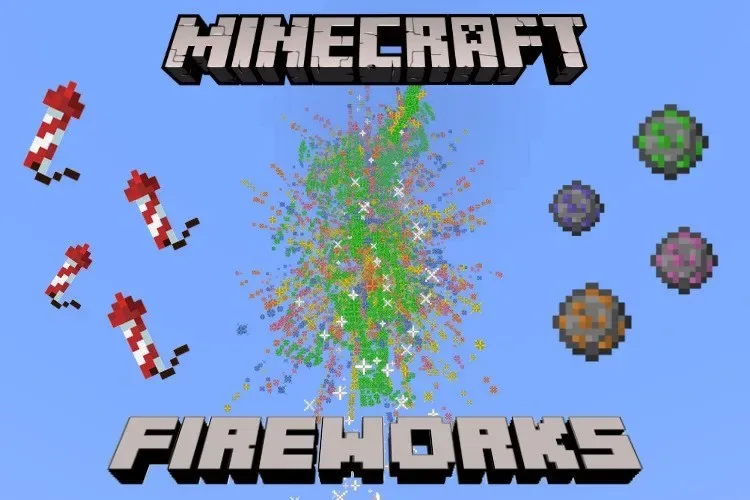
A firework star is where the show lives. Craft a star from gunpowder, any dye, and optional extra ingredients, then add the star to the rocket recipe (paper, gunpowder and one or more stars) and the rocket will explode into that star's colours and effects when it burns out. One rocket can carry several stars, which then burst together for a layered display.
The classic extra ingredients are worth learning, because they are the vocabulary of every display. Glowstone dust makes the burst twinkle and crackle as it fades. A diamond gives the particles a trail as they fall. A feather turns the explosion into an irregular burst rather than a neat sphere. A fire charge makes a much larger ball, a gold nugget makes a star-shaped burst, and a mob head produces a creeper-face explosion. A second round of crafting can add a fade, so the burst changes from one colour to another as it dies. None of this affects flight; it is pure theatre.
How do fireworks work as elytra boosters?
While gliding, use a rocket and it fires in the direction you are facing, dragging you with it in a burst of acceleration. Chain rockets to climb, level out into a glide to stretch the distance, then boost again. The technique that matters is aim: point where you want to go before you fire, because the rocket commits you to that line. Only use plain rockets with no star for flying. A star rocket explodes, and an explosion going off in your own face mid-flight does real damage and wrecks your trajectory.
Duration choice is a genuine trade-off. A one-gunpowder rocket gives a short, cheap nudge and fine control in tight spaces, which suits exploring and landing. Longer rockets carry you further per item and are better for cross-country cruising at altitude, but they are harder to steer mid-burn and wasteful if you only needed a hop over one mountain.
Can you fire rockets from a crossbow or dispenser?
Yes to both, and the crossbow version turns fireworks into a weapon. Load a rocket into a crossbow just like an arrow and it fires flat and fast rather than climbing; with a star rocket this delivers an explosion to whatever it hits, and a Multishot crossbow sends three at once. The damage is respectable but the cost is high, and you will set fire to the scenery's day either way, so treat it as a novelty weapon or a siege tool rather than everyday kit.
Dispensers are the display builder's friend. Wired to a redstone clock, a row of dispensers loaded with star rockets fires a choreographed show on repeat, and varying the flight durations mixes the burst heights so the sky fills at several levels at once. It is the reliable way to celebrate finishing a big build.
Are fireworks dangerous?
Plain rockets, no. Star rockets, genuinely yes. The burst is an explosion, and a rocket that detonates against a wall, a tree or the ground next to you will hurt you and anyone standing nearby. Chorus-line accidents usually happen at shows, where a mistimed rocket hits the underside of a roof and bursts at head height in a crowd. Keep display rockets aimed at open sky, keep spectators back from the launchers, and never hold a star rocket in your hand while flying. Respect those three rules and fireworks stay what they should be: the loudest, brightest and most joyful item in the game, and the reason your elytra never runs out of sky.
Frequently Asked Questions
How do you make a firework rocket fly further?
Add more gunpowder when you craft it. One gunpowder gives a short flight, two a medium one and three the longest. For elytra flying, most players prefer the short one-gunpowder version for control.
What is a firework star for?
A star adds the explosion to a rocket: colour, shape and effects. Glowstone dust adds a twinkle, a diamond adds trails, a feather makes a burst shape, and a fire charge makes a much larger ball.
Can firework rockets hurt you?
Plain rockets cannot, but star rockets explode and deal real damage. Never use a star rocket to boost an elytra, and keep display rockets aimed at open sky away from walls and roofs.
Can you shoot fireworks from a crossbow?
Yes. A crossbow fires a loaded rocket in a flat line, and star rockets explode on impact, making them an expensive but effective weapon. A Multishot crossbow fires three at once.