Minecraft Lecterns: Shared Books, Page Signals and Librarian Jobs
How to craft a lectern, why one shared book beats a chest full of copies, the comparator page-signal trick, and how the lectern creates librarians — plus how it differs from a chiseled bookshelf.
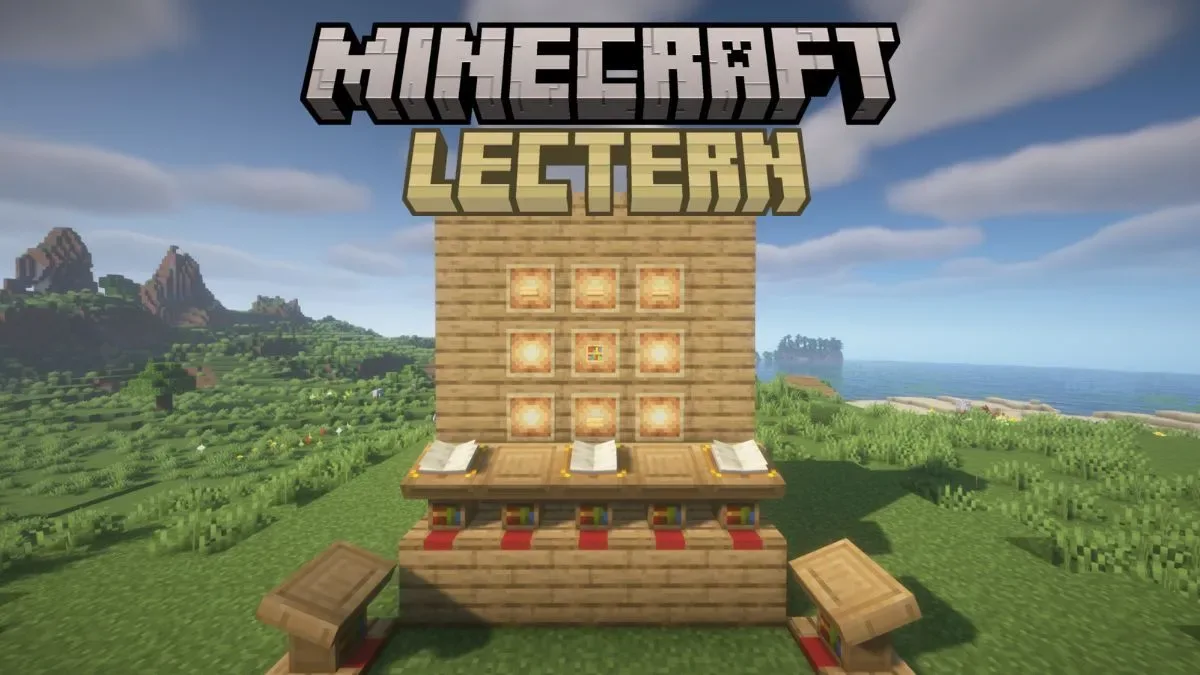
How to craft a lectern, why one shared book beats a chest full of copies, the comparator page-signal trick, and how the lectern creates librarians — plus how it differs from a chiseled bookshelf.
A lectern is a book stand with ambitions. It holds a single book where a whole room can read it, it quietly powers one of the neatest redstone tricks in the game, and it is the block that turns an unemployed villager into a librarian. If you have ever wanted a rulebook at a server spawn, a story at the front of a library, or a signal that changes as your visitors turn the pages, this modest piece of furniture is the answer.
How do you craft and use a lectern?
The recipe is four wooden slabs arranged around a bookshelf. Place the lectern, then use a book and quill — or a finished, signed written book — on it, and the book sits open on the stand, angled towards whoever walks up. Anyone can then read it exactly where it stands: no taking it away, no copies needed. The book can be taken back off with a quick interaction, and breaking the lectern returns it as well. One limitation surprises people: you cannot edit a book while it sits on the lectern. Take it down to make changes — and remember that once a book has been signed and finished, nobody can edit it ever again, lectern or not.
Why is a shared book better than a book in a chest?
Because only one copy exists, everybody reads the same words, on the same page. That makes the lectern the natural home for everything a multiplayer world runs on: the rules board at spawn, the price list in a market hall, the guest book in a tavern, the quest briefing at the start of an adventure map. In a single-player world it shines as a cookbook in a kitchen, a journal by the base entrance, or a chapter heading at the start of a long build. A book on a lectern is furniture that talks, and it invites reading in a way a book buried at the bottom of a chest simply never does.
How does a lectern talk to redstone?
Put a book on a lectern and the block itself gives out a weak redstone signal, enough to prove a book is present. The clever part needs a comparator. A comparator reading a lectern measures how far through the book the currently open page is: turn towards the end and the signal strength climbs; turn back towards the front and it falls. Mapmakers build puzzles on exactly this — the right page opens the door — and contraption builders use long books as cheap, compact dials, with the reader selecting a signal strength just by choosing where to stop reading. It is one of the very few redstone inputs that a player operates by doing something as gentle as turning a page.
What does a lectern do for villagers?
The lectern is the librarian's job block. An unemployed villager who can reach one will claim it and take up the trade, offering paper, bookshelves, enchanted books and name tags among the rest of the librarian's stock. That makes the lectern a small economy in a single block. Villages generate with them in their libraries, and players place and replace them deliberately when cycling a librarian's first trade in search of one particular enchanted book. If your villager refuses the job, check the obvious: another lectern nearby may already be claimed, the path to it may be blocked, or the villager may be a nitwit in the green coat, who never works at all.
How does a lectern compare with a chiseled bookshelf?
They look like cousins but do opposite jobs. A lectern displays one book for reading, and drives signals from whichever page it has been left open at. A chiseled bookshelf stores up to six books in individual slots, like a filing cabinet with better joinery; a comparator can sense its contents being changed, but nothing stored in it can be opened and read in place. Use the lectern for the book everybody should actually read — the rules, the story, the prices. Use chiseled bookshelves to shelve a collection, and to build library walls that are genuinely, functionally full of books rather than merely decorated to look that way.
Frequently Asked Questions
How do you craft a lectern in Minecraft?
Arrange four wooden slabs around a bookshelf on a crafting table. Then use a book and quill or a written book on the lectern to place it, and anyone can read it where it stands.
Can two players read a lectern book at the same time?
Yes. Everyone reading a lectern looks at the same book and the same page, which is why lecterns work so well for rulebooks, price lists and guest books in multiplayer worlds.
What villager job does a lectern create?
The lectern is the librarian's job site block. An unemployed villager who can reach one becomes a librarian, selling paper, bookshelves, enchanted books and name tags at higher levels.
What does a comparator do with a lectern?
It outputs a signal based on how far through the book the open page is. Turn deeper into the book and the signal climbs, which lets mapmakers build page-based puzzles and dials.