Minecraft Shield: Crafting, Blocking and the Axe Problem
Six planks and one iron ingot block arrows, melee hits and creeper blasts — until an axe comes along. Shield crafting, blocking rules and disables explained.
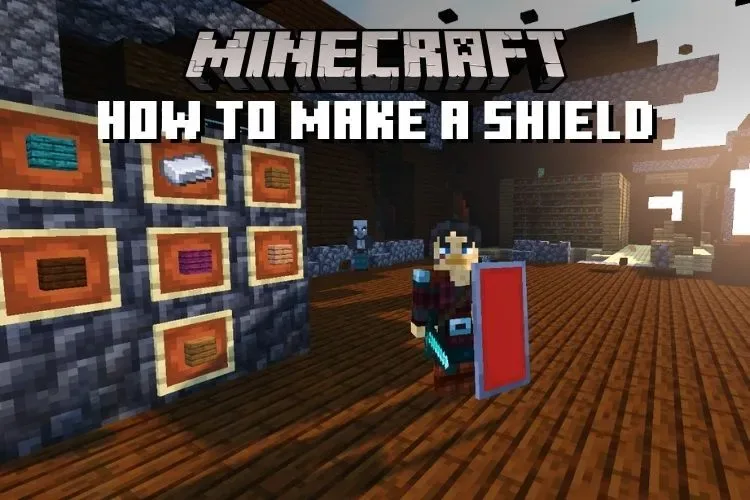
Six planks and one iron ingot block arrows, melee hits and creeper blasts — until an axe comes along. Shield crafting, blocking rules and disables explained.
A shield is the cheapest life insurance in Minecraft: one plank pattern and a single iron ingot buys you a raised wall that blocks melee hits, arrows and even point-blank creeper blasts. Hold it up with your off-hand and incoming frontal damage simply stops — for as long as you remember the shield's few, learnable weaknesses.
How do you craft and use a shield?
Arrange six wooden planks in a Y shape around one iron ingot at a crafting table. The shield goes in your off-hand slot, and crouching (or right-clicking on Java) raises it in front of you; on Bedrock, crouching is the raise. While raised, attacks striking the shield from the front are blocked and you take knockback instead of damage in most cases.
Raised shields slow you to a crawl, so the rhythm is block, drop, strike, block again. You can keep a sword in your main hand throughout — the shield never occupies it — which is why sword-and-shield becomes the default fighting style for many players from the first night onward.
What can a shield block?
Almost everything that arrives as a projectile or a swing from the front. Arrows are deflected (skeleton arrows bounce off, sometimes straight back into trouble), melee hits from zombies, spiders and vindicators are neutralised, and a creeper exploding against a raised shield deals no damage to you, though the blast still wrecks the ground. Guardian beams, blaze fireballs and shulker bullets are also stopped, making the shield the safest way to cross an ocean monument's courtyard or an End city's open rooms.
The shield has a facing, though. Hits from behind, from directly above, or from effects that are not attacks at all — fall damage, fire, potions, a warden's sonic boom — ignore it entirely. Positioning is half the skill: keep the danger in front of you and the shield does the rest.
Why does an axe sometimes smash your shield down?
Axes are the shield's natural counter. A hit from an axe has a chance to disable your shield — it drops, unusable, for a few seconds — and sprinting with the axe or striking with certain enchantments makes the disable more likely. Vindicators carry axes for exactly this reason, and in player-versus-player fights the axe is the standard answer to a turtling opponent.
When your shield is disabled mid-fight, do not stand there waiting for it to return. Back away, break line of sight, or switch to offence; five seconds without a block is survivable if you move, and fatal if you keep crouching in place. Pillagers with axes in raids follow the same rule, so treat any axe-wielding mob as the priority target.
Can you decorate or enchant a shield?
On Java Edition, applying a banner to a shield in the crafting grid copies the banner's pattern onto its face — pure decoration, and a favourite way to mark a faction or a base. Bedrock shields cannot take banner patterns. For enchantments, shields accept Unbreaking and Mending through an anvil with enchanted books; there is no shield-specific enchantment, which keeps the choice simple.
Durability is generous but not endless. Every blocked hit wears the shield down a little, and it will eventually snap mid-fight if you never check it. Mending solves that permanently; until then, carry the recipe in your head — six planks and an ingot is a small price the second time, too.
How do you fight well behind a shield?
The basic loop is patience: raise the shield, let the mob's swing break against it, then drop and answer with your own hit while it recovers. Skeletons reward a different read — walk towards them shield-first, letting arrows bounce away, until you are close enough to strike between their shots. Against creepers, raising the shield and simply standing your ground is safer than sprinting: the explosion costs you nothing but durability, and the creeper is gone.
Watch your flanks while you learn, because the instinct to crouch still is the beginner's mistake the shield encourages. Strafe slowly, keep turning to face new threats, and treat the shield as a door you open and close rather than a wall you live behind.
When is a shield the wrong choice?
Against the warden, whose sonic attack passes straight through; against anything attacking from above in a ravine; and whenever speed matters more than safety, since raising it slows you badly. Everywhere else — which is most of Minecraft's combat — the raised shield is the difference between a fair fight and a respawn screen.
Frequently Asked Questions
How do you use a shield in Minecraft?
Place it in your off-hand slot and crouch (or right-click in Java Edition) to raise it. Frontal melee hits and projectiles are then blocked while it is up.
Can a shield block a creeper explosion?
Yes. A creeper detonating against a raised shield deals no damage to you, although it still damages the terrain around you.
Why does your shield sometimes stop working after an axe hit?
Axes can disable a shield for a few seconds when they strike it. Axe-carrying mobs like vindicators, and players in PvP, use this to break your defence.
Can shields be enchanted or decorated?
Shields accept Unbreaking and Mending via an anvil. In Java Edition you can also apply a banner pattern; Bedrock Edition does not support banner designs on shields.