Minecraft Smithing Table: Netherite Upgrades and Armour Trims
The smithing table turns diamond gear into netherite and dresses armour in decorative trims — if you have the templates. Where templates hide, how duplication works, and why this cheap block becomes essential late in the game.
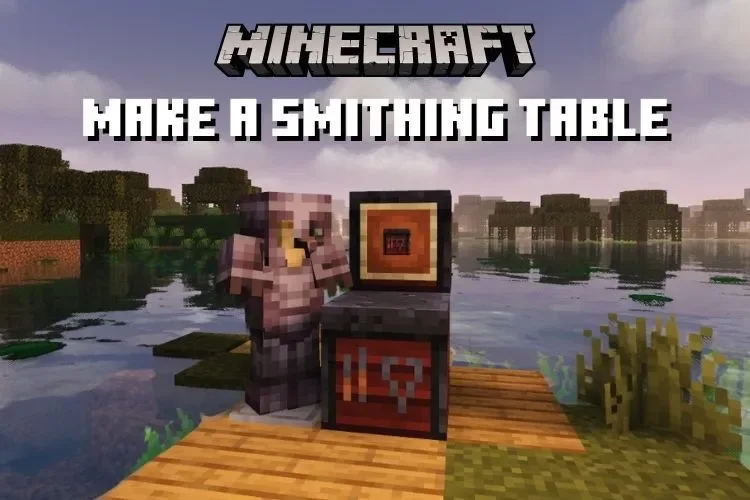
The smithing table turns diamond gear into netherite and dresses armour in decorative trims — if you have the templates. Where templates hide, how duplication works, and why this cheap block becomes essential late in the game.
A smithing table is the workstation where you upgrade diamond gear to netherite and decorate armour with trims, using special templates that you slot in alongside the piece you want to change. It does not work like a crafting table — nothing is built from raw materials here; instead, existing equipment goes in one side and comes out improved, or wearing a new pattern, on the other.
How do you get a smithing table?
They are simple to craft from wood planks and iron, cheap enough that most players make one in their first hour or two. You will also find them already standing in villages, where the table is the job block for the toolsmith villager. Claiming a village table for yourself is perfectly fine, though if you want the villager to keep his trade, leave him one to work at.
Because they cost so little, there is no reason to travel back and forth to a single table. Keep one at every base, outpost and Nether hub where you maintain your gear.
What are smithing templates?
Templates are the key item the table revolves around. A template is a flat, patterned item that tells the table what transformation to perform, and it sits in the left-hand slot of the table's interface. There are two families: upgrade templates, which change what a piece of gear is made from, and armour trim templates, which change only how armour looks.
Templates are found, not crafted from scratch — they turn up in chests in structures across all three dimensions, from ocean ruins and shipwrecks to bastions and ancient cities. The good news is that a template is never consumed by the table. Better still, you can duplicate one on a crafting table using diamonds and the material the template is themed around, so a single lucky find can supply your whole armoury.
How do you upgrade diamond gear to netherite?
This is the table's headline job, and it needs one specific template: the netherite upgrade, found in bastion remnants in the Nether. Put the template in the first slot, your diamond tool, weapon or armour piece in the second, and a netherite ingot in the third. Out comes the same item in netherite form.
Crucially, the upgrade preserves everything about the original piece. Enchantments, names, durability wear — all of it carries across, so your perfect diamond sword simply becomes a perfect netherite sword. Netherite gear is stronger, lasts longer, knocks back less when you are hit wearing it, and does not burn in lava or fire, which makes the upgrade worth the considerable effort of finding that template.
What do armour trims do?
Trims are pure decoration, and none the worse for it. Combine a trim template, a piece of armour and a mineral material — the likes of iron, gold, copper, emerald, lapis, redstone, amethyst, quartz, diamond or netherite — and the armour gains a coloured pattern in that material's hue. Every template has its own design, named after where it is found or what it depicts, and collecting the full set is a long-term treasure hunt in its own right.
- Trims change appearance only; protection values stay exactly the same.
- The same trim in different materials looks dramatically different, so experiment before committing rare minerals.
- Trimmed armour keeps its trim if you later upgrade it to netherite at the same table.
Where do you find the templates?
Every template lives somewhere specific, which turns collecting them into a tour of the game's structures. Trim templates turn up in places like shipwrecks, ocean monuments, jungle temples, desert pyramids, pillager outposts, strongholds, ancient cities, bastions and the End cities, with the rarest designs guarded in the most dangerous locations. The netherite upgrade template belongs to bastion remnants, and some bastions are far stingier with it than others, so expect to clear more than one before you strike lucky.
Because each template can be duplicated with diamonds once you own one, the hunt is really for the first copy of each design. After that, your crafting table becomes the printing press.
Is the smithing table worth bothering with early on?
Honestly, its early-game role is modest: until you have diamonds, a template and something worth upgrading, the table mostly sits there looking handsome. But the moment you start delving into structures and coming home with templates, it becomes essential infrastructure — the only route to netherite gear and the only way to trim armour. Build one early, park it by your enchanting setup, and forget about it until the day it becomes the most important block in the room.
Frequently Asked Questions
What is a smithing table used for?
It upgrades diamond gear to netherite and applies decorative armour trims, using smithing templates placed in its first slot.
Where do you find the netherite upgrade template?
In bastion remnants in the Nether. Once you have one, you can duplicate it on a crafting table using diamonds rather than hunting for more.
Does upgrading to netherite remove enchantments?
No. The upgrade keeps the item's enchantments, name and durability — your diamond gear simply becomes the netherite version of itself.
Do armour trims make armour stronger?
No. Trims are purely decorative patterns. They change how armour looks, never how much protection it gives.