Minecraft Sugar Cane Farm: A Simple Automatic Design
Let observers and pistons do the harvesting. How an automatic sugar cane farm works, how to collect every drop, and why size beats clever redstone.
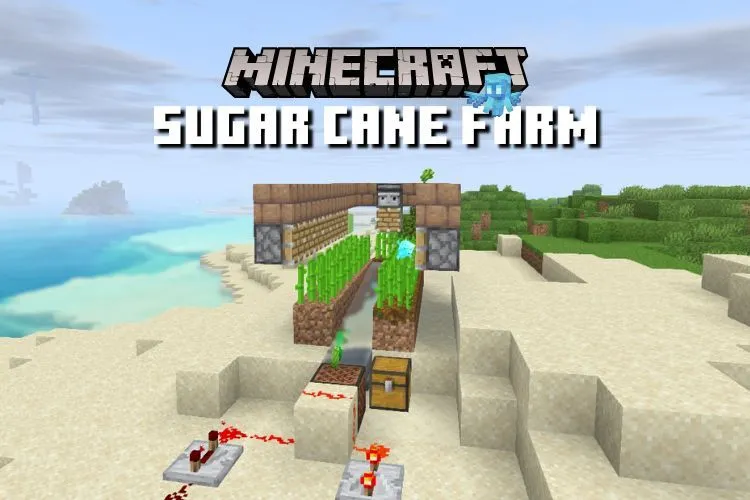
Let observers and pistons do the harvesting. How an automatic sugar cane farm works, how to collect every drop, and why size beats clever redstone.
A sugar cane farm automates one of the dullest harvests in Minecraft: instead of walking the riverbank punching cane by hand, an observer watches each plant grow and fires a piston the moment it reaches full height, knocking the upper sections into a water stream that delivers them to a chest. Build even a modest row of these modules and paper, sugar and rockets for your elytra quietly stockpile while you do something more interesting.
Why does sugar cane need water right beside it?
Sugar cane only plants on grass, dirt, sand and a few similar blocks that sit directly next to water, and it keeps that requirement for its whole life. It grows in stacked sections, usually up to three tall, and it never needs light, which is why natural cane hugs rivers and lake edges. Your farm copies that shoreline in a controlled strip: a channel of water, a row of sand or dirt along it, and cane on every planting spot. Leave the bottom section standing whenever you harvest, because a cane plant regrows from its base — knock the whole thing down and you would have to replant by hand.
How does the automatic harvesting actually work?
Each module pairs one cane with an observer and a piston. The observer faces the plant at the height of its third section, and when that section appears, the observer sends a pulse into the piston behind the cane. The piston extends for a moment, breaking the second and third sections while leaving the base untouched, and the dropped items land in the water channel or on the ground beside it. Redstone dust carries the pulse the short distance between observer and piston, and because every module is independent, you can tile them along a shared water channel as far as your patience and iron supply allow.
How do you collect the drops without losing any?
The simplest collection is a water stream running along the front of the farm at ground level: broken cane falls in, floats to one end, and drops into a hopper feeding a chest. Watch the first few harvests, because occasionally a piece lands on the planting row instead of in the stream and despawns if nobody picks it up. Raising the water channel slightly, or running a hopper minecart on a rail beneath a floor the items can fall through, catches those stragglers. A minecart system costs more iron but suits a wide farm where a single water stream would need to run a long way.
Does farm size matter more than clever design?
Mostly, yes. Sugar cane grows on random ticks, so each plant produces at its own uneven pace and no redstone trick changes that. Doubling the number of plants roughly doubles your income, whereas squeezing a slightly faster harvest cycle out of the redstone gains almost nothing, because the piston work takes a moment while the growing takes far longer. Start with eight to sixteen modules, live with it for a while, and extend the row when you know your actual usage — rocket fliers burn through paper far faster than players who only need the odd book or cake.
Can you speed the farm up with bonemeal?
Not on Java Edition, where bonemeal does nothing to sugar cane — a fact that surprises many players, because it works on most other crops. Bedrock Edition is the exception: there, bonemeal does grow cane taller, so Bedrock players can pair a dispenser of bonemeal with the observer design for a much faster farm. Java players chasing volume should simply build longer rows and let the farm run while they work nearby, since the plants only tick when the chunks are loaded. If you afk beside it, stay close enough to keep the farm in simulation range but somewhere safe from wandering mobs.
Where should you build it?
Anywhere flat near your base works, because the farm carries its own water with it and needs no natural river. Many players tuck a row along the inside wall of a storage room or under a floor with the collection chest at one end, so the harvest appears where it will be used. Keep the water channels covered or fenced if your base sees hostile mobs at night — a creeper explosion in the middle of the planting row means replanting by hand, which is exactly the job the farm exists to remove.
Frequently Asked Questions
How tall should you let sugar cane grow before harvesting?
Three sections is the standard trigger height. Set the observer to watch the third section so the piston breaks the top two and leaves the base standing to regrow, which keeps the farm fully self-sustaining.
Why is my sugar cane not growing?
Check that every plant still sits directly beside water and that you are close enough for the chunks to be loaded and ticking. Cane also grows slowly and unevenly, so a quiet ten minutes is not necessarily a fault.
Can you bonemeal sugar cane to make it grow faster?
On Bedrock Edition, yes — bonemeal grows cane taller and can feed a fast dispenser-based design. On Java Edition bonemeal has no effect on sugar cane at all, so longer rows are the only way to raise output.
What is sugar cane most useful for?
Paper is the big one: it becomes books, maps and, combined with gunpowder, the firework rockets that power elytra flight. Cane also refines into sugar for cakes, potions of swiftness and fermented spider eyes.