Minecraft Tree Farm: Grow Your Own Endless Forest
Saplings in, logs out, forever. How bonemeal-powered tree farms work, which trees cooperate, and why the fully automatic designs belong to Java.
Saplings in, logs out, forever. How bonemeal-powered tree farms work, which trees cooperate, and why the fully automatic designs belong to Java.
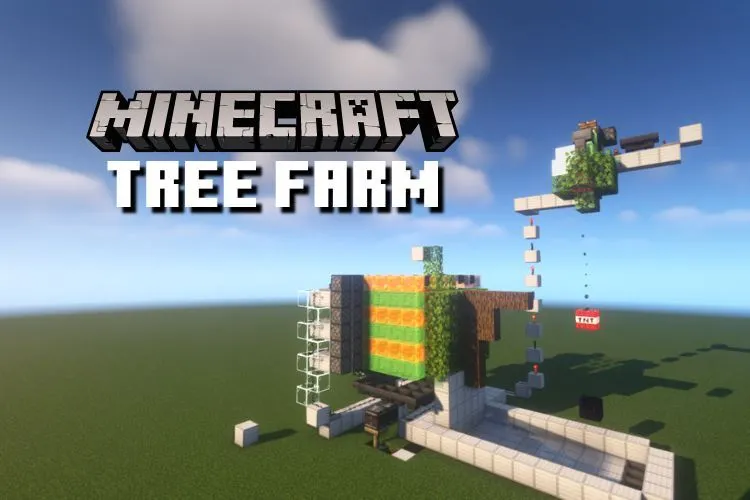
A tree farm turns saplings and bonemeal into a self-renewing wood supply, so you stop stripping the landscape bare every time a build eats a few thousand logs. The simple version is a tidy orchard you harvest by hand; the proper farm adds a bonemeal dispenser to force instant growth and, for the keen, piston or blast-chamber systems that break the trunk down for you.
What does a basic semi-automatic tree farm look like?
The core is one sapling on a dirt block, a dispenser full of bonemeal aimed at it, and a clock or button that fires the dispenser until the tree grows. Oak is the usual candidate: it grows compactly, asks for little headroom, and its small form fits under a low ceiling that stops the game choosing a huge, sprawling shape. Once the tree pops in, you chop it down yourself, catch the falling saplings and apples, replant, and go again. It sounds plain, and it is — but it converts a skeleton farm's spare bones into unlimited wood at a rate manual forest trips cannot touch.
Why does bonemeal supply make or break the farm?
Bonemeal is the fuel, and trees drink it. Some saplings grow after a couple of doses, others stubbornly take far more, and that randomness means a tree farm without a real bonemeal pipeline behind it stalls quickly. Pair it with something that produces bonemeal in bulk: a skeleton spawner farm is the classic partner, while a composter fed by a melon, pumpkin or kelp farm makes bonemeal from crops instead. Think of the tree farm and its bonemeal source as one combined machine, and size the second before you boast about the first.
Which trees farm well and which refuse to cooperate?
Oak, birch and spruce are the cooperative ones, growing from single saplings in predictable shapes. Spruce has a bonus trick: plant four saplings in a square and bonemeal produces a giant spruce with a very generous log count. Jungle saplings can be farmed the same four-way way but need more room. The difficult cases are trees whose growth needs specific conditions or big open space — dark oak demands four saplings and plenty of sky, cherry and mangrove behave by their own rules, and acacia's bent trunks make fully automatic harvesting awkward. For pure log output per bonemeal, most players settle on oak for simplicity or giant spruce for volume.
Can the farm chop the tree down by itself?
On Java Edition, largely yes: advanced designs push the grown trunk sideways with pistons into a blast chamber, where TNT breaks the logs into items for collection. That machinery leans on Java's TNT duplication mechanic, which is why those spectacular fully automatic designs are a Java speciality — Bedrock Edition does not duplicate TNT, so Bedrock tree farms stay semi-automatic: machine-grown trees, harvested by hand or by simpler means. Even on Java, many experienced players skip the blast chamber; the complexity is real, and hand-chopping a machine-grown oak every few seconds is hardly slow.
How much space and height does a tree farm need?
More than new builders expect. Each tree type has a minimum clear column above its sapling, and if a roof, branch or stray block intrudes, the growth attempt simply fails and quietly wastes bonemeal. Builders often deliberately cap the height with a ceiling at the small-tree limit, which forces compact shapes and stops surprise giant oaks from smashing through the machinery. Leave room around the trunk too: leaves spread wider than the wood, and a cramped farm chokes on its own foliage, slowing replanting and swallowing drops.
Where does a tree farm belong in your base?
Put it beside its suppliers and its customers: near the skeleton farm or composter line that feeds it bonemeal, and near the storage or furnace room that consumes the logs. A small footprint design fits in a corner of a workshop, but leave yourself elbow room at the growth spot — you will be standing there swinging an axe in a steady rhythm, and a cramped cell with leaves in your face makes a relaxing job tedious. Good lighting, a double chest for logs and a dedicated sapling bin turn the corner into a proper little lumber station.
What do you do with the leaves and spare saplings?
Mostly, compost them — the farm produces saplings well beyond replanting needs, and feeding the excess back into a composter returns some of the bonemeal the farm consumed, closing the loop a little. Shears or a hoe make leaf-clearing quick, and an Efficiency-axed sprint through the trunk keeps the rhythm pleasant. Apples from oak leaves are a small but welcome side income. Just never let the leaf canopy merge with a neighbouring tree's: one combined leaf mass slows everything down and turns a tidy cycle into gardening.
Frequently Asked Questions
What is the best tree to farm in Minecraft?
Oak is the easiest — compact, undemanding and reliable under a low ceiling. For sheer log volume, four spruce saplings grown together into a giant spruce are hard to beat, at the cost of more space and bonemeal.
How do you keep a tree farm supplied with bonemeal?
Build the supply first: a skeleton farm turns bones into bonemeal directly, while composters fed by crop farms make it from plant waste. Composting the tree farm's own spare saplings also returns a little of what it spends.
Can you fully automate a tree farm on Bedrock?
Not in the Java showcase style. The fully automatic designs rely on TNT duplication, which does not exist in Bedrock Edition, so Bedrock tree farms are semi-automatic — bonemeal dispensers grow the trees and you harvest them.
Why won't my sapling grow with bonemeal?
It almost always needs more clear space above or around it. Remove roofs and stray blocks from the growth column, or fit a deliberate ceiling at the height for the tree's small form so failed giant growths stop wasting bonemeal.