Genshin Impact Collectibles Guide: Oculi, Chests, Seelies and Exploration Systems
How Oculi work in every region, the extra collection tracks like Crimson Agate and Spirit Carp, chest tiers explained, and what Seelies and time trials reward you with.
How Oculi work in every region, the extra collection tracks like Crimson Agate and Spirit Carp, chest tiers explained, and what Seelies and time trials reward you with.
Exploring Teyvat runs on a handful of interlocking collectible systems: Oculi to feed each region's statues, four tiers of treasure chests, Seelies and time trials that hide still more chests, and regional offering systems that turn leftover exploration currency into rewards. None of it respawns and none of it is random — everything you can collect was placed by hand — so a region at 100% exploration really does mean you found it all.
What are Oculi, and why does every region have its own?
Oculi are small orbs of elemental energy scattered across the open world, usually perched somewhere that makes you climb, glide or solve something small to reach them. Each nation has its own type, named for its element: Anemoculi in Mondstadt, Geoculi in Liyue, Electroculi in Inazuma, Dendroculi in Sumeru, Hydroculi in Fontaine and Pyroculi in Natlan. The counts climbed as the world grew — 66 Anemoculi, 131 Geoculi and 181 Electroculi in the older nations, rising to 271 each in Sumeru, Fontaine and Natlan.
Nod-Krai and Snezhnaya continue the pattern in their own ways. Nod-Krai's Lunoculi, 271 in total once its expansions finished, are offered to Statues of the New Moon rather than the Seven. Snezhnaya's Cryoculi are still being rolled out with the new region — around 230 are available as of Version 7.2, of an expected 271 — so its statue cannot be maxed just yet. Everywhere else, finishing a statue leaves exactly one spare Oculus in your bag, a tradition players have kept as a souvenir for years. If the last few elude you, each region offers a craftable Oculus Resonance Stone that points at the nearest one.
What other regional collectibles sit alongside Oculi?
Several sub-regions run a second collection track with its own offering altar. Dragonspine's Crimson Agate feeds the Frostbearing Tree, the Chasm's Lumenspar upgrades the Lumenstone Adjuvant gadget that lights your way underground, and Chenyu Vale's Spirit Carp are offered at the Rainjade's Benediction. Sumeru's desert adds Plumes of Purifying Light for the Amrita Pool. Each of these works like a small statue: gather the items through exploration, hand them in, and climb a reward track of Primogems, materials and gadgets.
Regional Sigils — the Anemo, Geo, Electro and other elemental Sigils you earn from chests and statues — plug into similar systems. In Mondstadt and Liyue they are simply spent in the souvenir shops, but from Inazuma onwards each nation has a grand offering: the Sacred Sakura, the Tree of Dreams, the Fountain of Lucine, the Tablet of Tona, and Nod-Krai's Meeting Points, which take Luna Sigils. These tracks are generous and permanent, so there is no rush — they wait until your exploration naturally fills them.
How do chest tiers work?
Chests come in four tiers: Common, Exquisite, Precious and Luxurious. The higher the tier, the better the haul — more Primogems, a bigger bundle of regional Sigils, Mora, enhancement materials and, in the early game, a useful drip of weapons and artefacts. Luxurious chests are the prizes at the end of world quest chains, long puzzle sequences and each Shrine of Depths, which needs a key earned from that region's statue and Domains.
Exact Primogem values vary by nation, with the older regions noticeably stingier than newer ones, but the structure never changes: chests are the single biggest source of exploration Primogems, and they never respawn. A chest locked behind a puzzle or a ring of enemies still counts the moment you open it — and opening chests is also what quietly pushes each area's exploration percentage upward.
What are Seelies and time trials for?
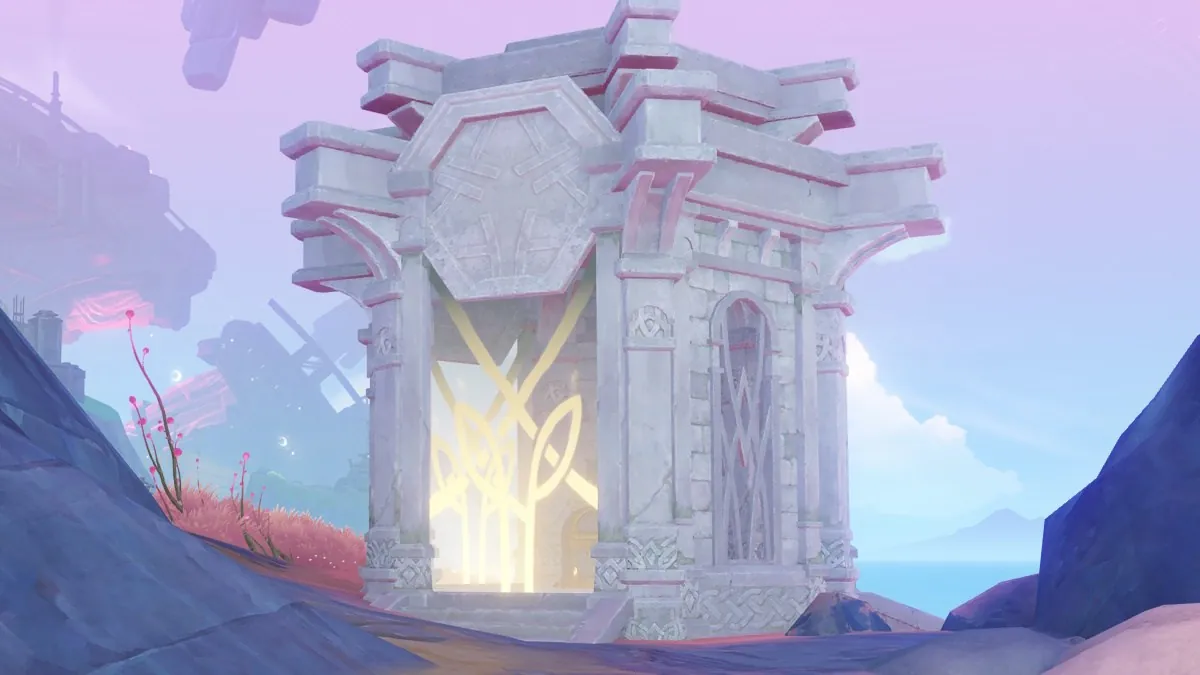
Seelies are the little spirits drifting across the landscape. Follow one back to its Seelie Court — the empty stone perch it circles home to — and a chest materialises as your reward. Some Seelies simply lead; others hide, race, or ask you to clear enemies on the way, and later regions dress the same idea in local costumes, from Electro Seelies in Inazuma to the spirit companions of Natlan and Nod-Krai.
Time trials are the other staple: touch the challenge totem, then reach the target, pop the balloons or beat the clock in whatever order the trial demands. Finish inside the limit and a chest appears, graded by how demanding the trial was. Together with elemental monuments, torch puzzles and combat arenas, these small set-pieces are how the game turns empty landscape into exploration progress — clear them as you pass, and the 100% completes itself.
Frequently Asked Questions
What are the different types of Oculi in Genshin Impact?
Each nation has its own: Anemoculi, Geoculi, Electroculi, Dendroculi, Hydroculi and Pyroculi, plus Lunoculi in Nod-Krai and Cryoculi in Snezhnaya. The big modern regions hold 271 each.
Do Oculi respawn in Genshin Impact?
No. Oculi are hand-placed and finite, like chests. Once you have offered enough to max a region's statue, exactly one spare Oculus of that type remains in your inventory.
How many chest tiers are there in Genshin Impact?
Four: Common, Exquisite, Precious and Luxurious. Higher tiers give more Primogems, Sigils and materials, and Luxurious chests usually reward quests, long puzzles and Shrines of Depths.
How do you find the last few Oculi in a region?
Craft that region's Oculus Resonance Stone. Using one marks the area of the nearest remaining Oculus on your map, which turns a painful final hunt into a short walk.