Redstone Repeaters: Boosting Signals and Setting Delays
One block that boosts, delays and directs your signals. The four tick settings, one-way flow, locking, and how a repeater differs from a comparator.
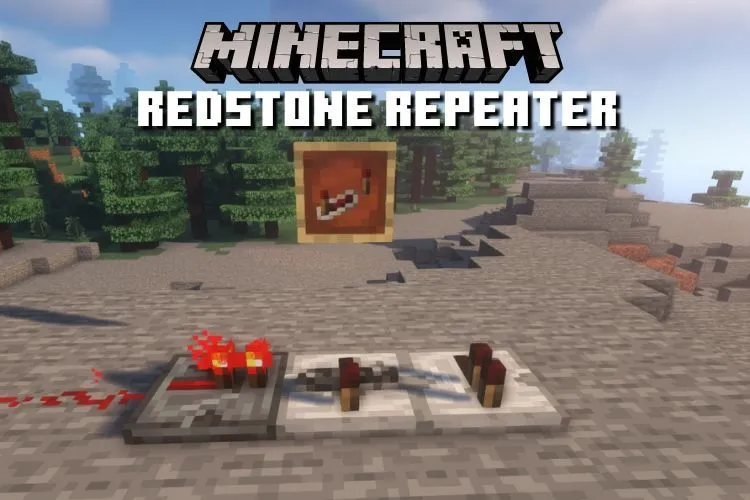
One block that boosts, delays and directs your signals. The four tick settings, one-way flow, locking, and how a repeater differs from a comparator.
A redstone repeater does three jobs in one small block: it boosts a fading signal back to full strength, it delays that signal by a fraction of a second, and it only lets power flow in one direction. Almost every circuit longer than a hallway or cleverer than a light switch has repeaters in it somewhere, quietly keeping time.
How do you craft a redstone repeater?
You need three stone blocks along the bottom of the crafting grid, two redstone torches, and one piece of redstone dust in the centre. Note that it is smooth, plain stone, not cobblestone: cook cobblestone in a furnace first if your chests are full of the rough stuff. The torches stand on the stone either side of the dust. It is a cheap recipe, and you will burn through stacks of them on any serious project.
What do the four delay settings do?
Right-click a placed repeater and its two torches shuffle closer together or further apart, cycling through four delays of one, two, three or four redstone ticks. A tick is a tenth of a second, so the longest setting buys you four-tenths of a second. That sounds trivial until you need a piston to fire after its neighbour, a dispenser to wait for a door, or a row of note blocks to play in sequence. Timing is a language, and these four settings are its first words.
How does a repeater boost a signal?
Redstone dust loses one point of strength per block and dies after fifteen. Feed whatever is left of a signal into the back of a repeater and it leaves the front at full strength fifteen again, ready for another fifteen blocks of dust. Long corridors, deep farms and any machine spread over a hillside all lean on chains of repeaters as pumps. Just remember the boost comes with the delay attached; every repeater in the chain adds its little pause.
Why does power only flow one way through a repeater?
Because a repeater is a diode: it accepts power at its back and emits it at its front, and signals cannot sneak through in reverse. That one-way behaviour stops circuits from backfiring into each other, which is invaluable when two machines share wiring or when a loop would otherwise feed itself. Place two lines of dust side by side with repeaters facing opposite ways and each keeps its own signal, a trick used everywhere from item counters to railway junctions.
What does it mean when a repeater locks?
If a powered repeater points directly into the side of another repeater, the second one locks: it freezes its output exactly as it is, on or off, and ignores its input until the side signal stops. The little bedrock-like bar that replaces its front torch is the giveaway. Locking is how builders build memory, holding a state long after the button that set it has been released. It is an advanced trick, but knowing it exists explains some mysterious contraptions you will meet.
How is a repeater different from a comparator?
A repeater repeats: whatever strength arrives, full strength leaves, later. A comparator measures: it can preserve the strength it receives, compare two signals, or subtract one from another, which is why comparators handle container fullness and sorting. If you need more time or more distance, reach for the repeater. If you need the circuit to know how much of something there is, that is comparator work.
Repeaters matter in tall builds too, even though they only ever sit flat and point sideways. Dust climbing a staircase of blocks loses strength with every step up, so any signal travelling between floors needs a repeater landing on each level to restore it, working alongside torch towers that do the actual vertical lifting. Miss one landing out and the top floor of the machine simply never hears the switch.
How do repeaters make a clock?
Run a repeater's output back into its own input through a loop of dust, add a lever to start and stop it, and the signal chases its own tail forever, ticking at whatever delay you set. Repeater loops are the standard adjustable clock: more repeaters, or higher settings, means a slower pulse. They drive flashing lights, farm harvesters and piston doors that open and close in sequence, and building one teaches you more about timing than any diagram.
Frequently Asked Questions
How do you change a repeater's delay?
Right-click the placed repeater. It cycles through four settings of one to four redstone ticks, and the gap between its two torches shows which setting it is on.
Can a repeater make a weak signal strong again?
Yes. Any signal fed into the back of a repeater comes out of the front at full strength fifteen, which lets it travel another fifteen blocks of dust.
Why won't my signal go through a repeater backwards?
Repeaters are one-way. Power enters the back and leaves the front only, which protects circuits from signals feeding back into places they should not reach.
What is the difference between a repeater and a comparator?
A repeater always outputs full strength and adds delay. A comparator preserves, compares or subtracts signal strengths, so it is used for measuring things like how full a container is.