Minecraft Villager Breeder Guide: Beds, Food and Baby Separation
How a villager breeder works in Minecraft: the beds and food that make villagers willing, farmer-fed designs, separating babies, and keeping the whole thing safe.
How a villager breeder works in Minecraft: the beds and food that make villagers willing, farmer-fed designs, separating babies, and keeping the whole thing safe.
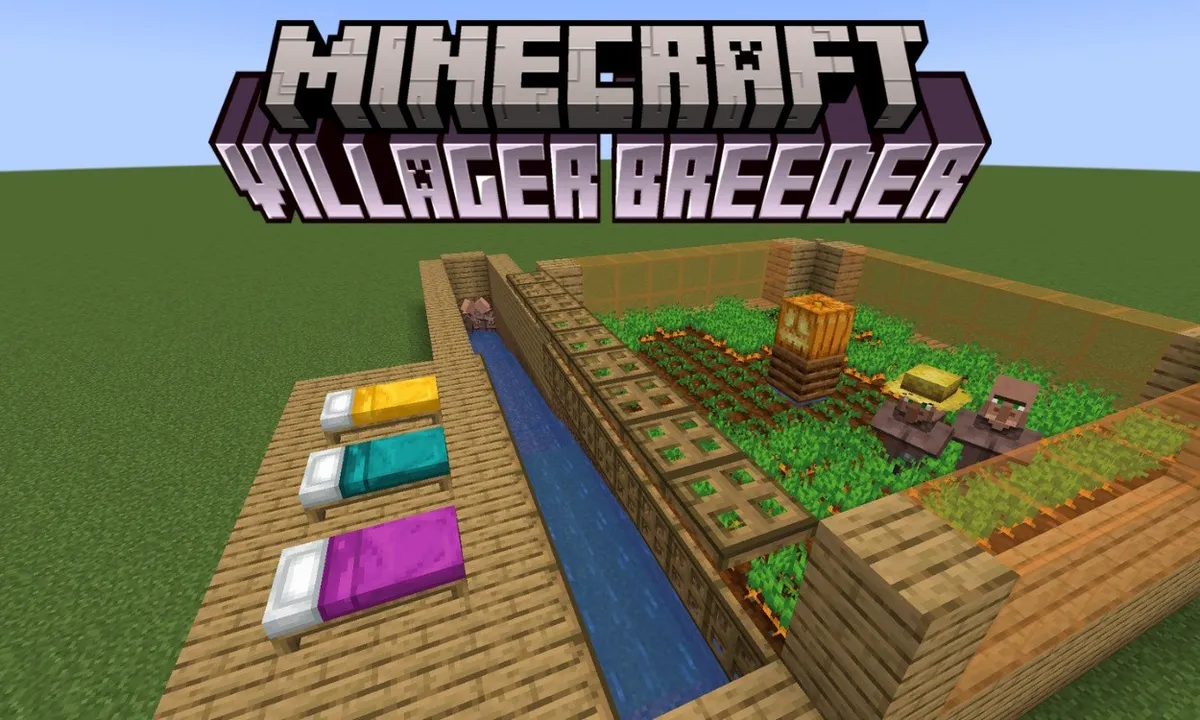
A villager breeder is a small farm that produces a steady supply of new villagers by keeping a pair of adults fed, rested and surrounded by spare beds. The whole design rests on one simple principle: villagers breed when there are more claimed beds than villagers, each adult has plenty of food in its inventory, and both of them feel like it — which they signal by tossing food to each other and hearts appearing overhead.
What does a villager need before it will breed?
Three ingredients matter: beds, food and a little headroom. There must be at least one unclaimed bed for every baby you want, and each bed needs two blocks of empty space above the pillow end so a child can actually appear and claim it. If the ceiling is too low, breeding silently fails, which is the single most common reason a fresh breeder "does nothing".
Food is the second condition. Villagers carry an invisible personal inventory, and breeding consumes food from it. Bread works best per slot, while carrots, potatoes and beetroot are easier to farm in bulk. An adult needs roughly a dozen carrots or potatoes, or a few loaves of bread, stashed away before it becomes willing.
How do you keep the adults fed without standing there?
The hands-off approach is to let the villagers feed themselves. Give the breeding pair access to a crop plot with a farmer villager working it, and the farmer will harvest, replant and share the surplus with the others — tossing food across the plot exactly the way villagers do in a natural village. That creates a loop: crops grow, the farmer shares, the pair breed, and the cycle repeats.
If you would rather keep things simple, feed them by hand. Drop stacks of carrots or bread at their feet and they will scoop them up. Manual feeding is fine for a small breeder producing a handful of villagers, but a self-feeding design wins once you need dozens for a trading hall or an iron farm.
How do you separate the babies from the adults?
A breeder that mixes babies in with the parents quickly stalls, because the children grow up, claim the spare beds and eat the food budget. Most designs solve this with a one-block gap, a trapdoor or a water channel that only the smaller baby hitbox can slip through — often helped by the fact that babies beeline for beds at night and pathfind differently from adults.
Once separated, babies are usually carried away in a water stream, a minecart or a boat to wherever you need them: a zombification-and-curing station for discounted trades, a trading hall, or a holding pen. Moving them while they are still babies is far easier than wrestling an adult into a minecart later.
Where should you build a breeder, and how do you keep it safe?
Build it somewhere you visit often, because villagers only tick and breed while the chunks around them are loaded. A spot near your base, a crop field or an iron farm is ideal. The enclosure itself should be fully walled and lit: a single zombie wandering in at night can kill the pair or, worse, infect them, and a lightning strike can turn a villager into a witch.
Keep the design modest at first. A pen with two adults, a farmer, a crop patch and a row of beds will quietly produce villagers faster than most players can use them. Scale comes from adding beds, not from making the machine complicated.
Does it work the same in Java and Bedrock?
Largely, yes — beds and food drive breeding in both editions. The main differences sit in the details: Bedrock ties village membership and bed claiming to its own village system, so a breeder too close to an existing village can merge with it and behave oddly. Give a Bedrock breeder clear distance from any natural village. Java players should also remember that a villager who has been traded with keeps its profession for life, while unemployed adults and babies are flexible — another reason to breed first and assign jobs later, wherever you play.
How do you grow a small breeder into a big one?
Scaling is mostly plumbing. Add beds in batches, lengthen the crop plot or add a second farmer, and improve the baby transport so children leave the cell promptly instead of clogging it. A breeder feeding a serious trading hall usually runs continuously in the background of a base rather than being switched on for a project — set it up early, let the population accumulate in a holding area, and draw villagers from stock whenever a new hall, farm or cure line needs one.
Frequently Asked Questions
Why is my villager breeder not producing babies?
Usually one of three things: there are no spare unclaimed beds, the beds lack two blocks of space above the pillow end, or the adults have run out of food. Check beds first, then throw the pair a stack of carrots or bread and watch for hearts.
What is the best food for a villager breeder?
Bread is the most efficient per item, but carrots and potatoes are easier to produce in bulk with an automatic crop farm. Any of bread, carrots, potatoes or beetroot will make villagers willing once they hold enough of it.
How do I stop babies staying with the adults?
Use a gap, trapdoor or water channel sized for the baby's smaller hitbox so children drift away from the breeding cell into a collection area. Separating them keeps spare beds free and stops grown children eating the food supply.
How many villagers can one breeder make?
As many as you have spare beds for. Each baby claims a bed, so keep adding beds and food and the pair will keep breeding — in practice, beds and your patience are the only limits.